
By Laura Connolly
It happened by word of mouth. Suzan Morgan talked with her oncologist, Dr. Peter Geggie, about the hype and research coming out of Vancouver about Breast Cancer and Dragon Boat paddling. Dr. Geggie then introduced her to Kelly Bryan, a patient and paddler on Canadian Air’s Dragon boat team, which paddled out of the Calgary Canoe Club.
Kathleen Kranenburg, a Canadian Women’s National Dragon Boat Team member, paddled out of the Calgary Canoe Club and became one of Sistership’s first coaches. Kathleen’s mother, Vicki Kranenburg, was on the Board of the Alberta Breast Cancer Society. She helped Vicki apply for and secure a start-up grant of $10,000 for a team.
Word travelled to patients, doctors’ offices and support groups like Wings of Hope and Young Women’s Support Group in Calgary. After Laura Connolly received a call from a nursing classmate who worked in a doctor’s office, who asked, “Do you want to go paddle a boat?”, the seeds were sown. She wondered if she would get wet.
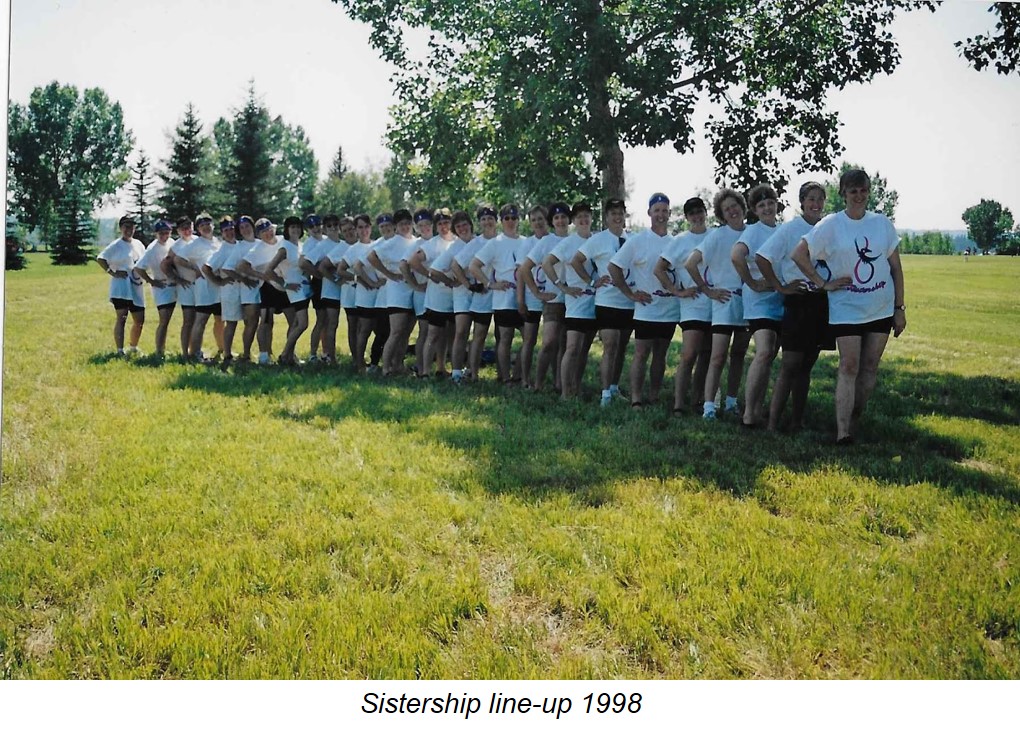
In November 1997, 15 women met at the Alberta Breast Cancer Society office to organize and choose a name. Thus, SISTERSHIP was born!
Dragon boat racing originated in China more than 2,500 years ago. What began as an attempt to save a beloved statesman and poet from a river suicide has grown into a cultural celebration in cities worldwide.
Dragon boat festivals display cultural diversity and often include music, dancing and martial art demonstrations. Races feature long, narrow boats made of fibreglass or teak and hold 20-22 paddlers, a drummer and a steersperson. On festival days, paddlers decorate the boats with colourful dragon heads and tails.
The notion of dragon boating for breast cancer survivors began in 1996. Dr. Don McKenzie, a sports medicine physician at the University of British Columbia, wanted to test the myth that repetitive upper-body exercise in women treated for breast cancer encouraged lymphedema. In fact, Dr. McKenzie believed that women could avoid lymphedema by following a unique exercise and training program while enjoy active lives.
To test his hypothesis, Dr. McKenzie launched Abreast In A Boat, a dragon boat team of 25 breast cancer survivors, as part of a medical study. He carefully monitored participants with a sports medicine physician, a physiotherapist and a nurse. At the end of the study, the results supported his theory. No new cases of lymphedema occurred, and none of the existing cases became worse.
The results of this study spurred more boats launched in Vancouver and inspired the formation of many other teams in Canada and around the world – of which, Sistership Calgary is one.